Apexing Strategy in Formula 1, IndyCar, NASCAR and Motor Racing
When watching motorsport, the average viewer might be led to believe that the line racing drivers take through a corner is clear evidence that their on-board GPS route tracker has gone on the blink. By the end of this article, hopefully I will have convinced you that this is not the case (on most occasions). Furthermore, I will also attempt to demonstrate that it takes years of practice to drive this badly, all over the road, with these wackadoodle lines.
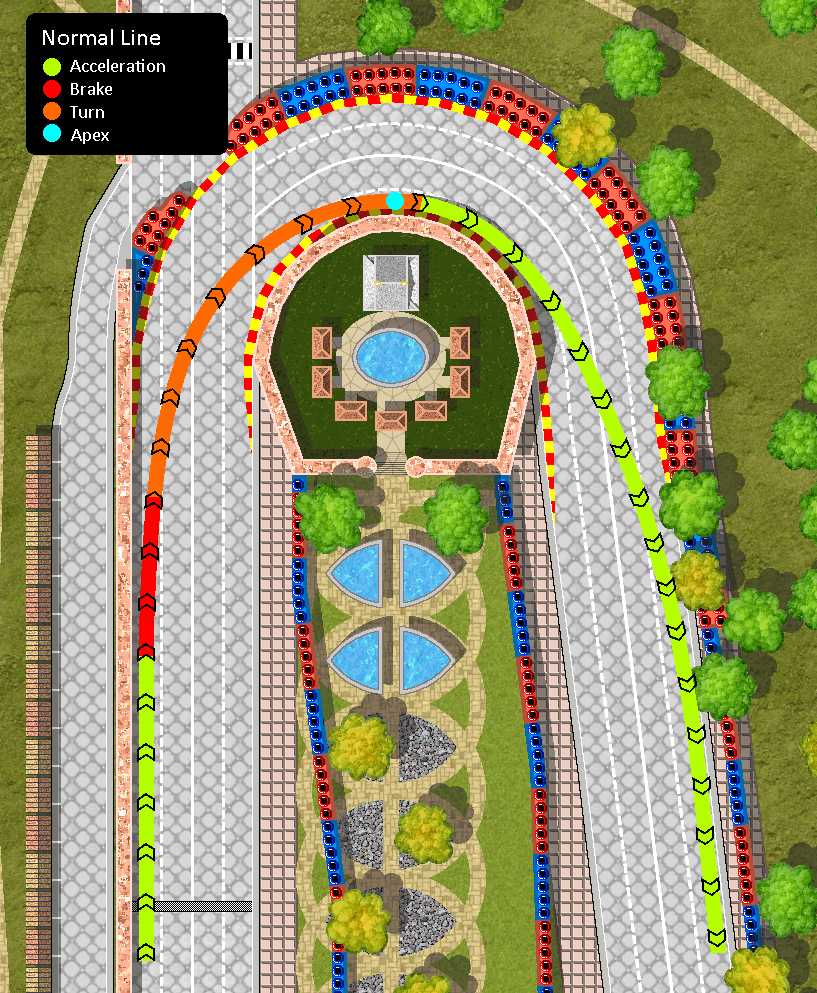
First off, we need to learn a few definitions related to shape. I know, I know, hang with it, it gets better. The inside of a corner is the side of the road with the shortest distance around the corner. In contrast, the outside of a corner is the side of the road with the greater distance around the corner. The middle of the road is the line between these two. Nothing too bewildering so far.
The average Joe might think that the best racing line, the route your car actually takes around a corner, is through the middle of the road. I hate to break it to Mr Average Joe, but he is wrong. Ignore him.
The racing line is a combination of the optimal line, braking zones and the best place to apply the accelerator again so you get around the corner in the fastest time possible, but retaining control of the car.
Typically, this line tries to minimise the amount of turning the car has to do on average. It also tries to place most of the turning in the corner where your car is slowest. This is because your car can turn more sharply without spinning when it is slow, but has limited turning ability when the car is fastest. When you combine all this techno-science, that is the racing line.
I hope you are taking notes, because there will be a written test at the end of all this. No talking at the back, and stop staring out of the window.
The starting point to try to find the best line is to reduce the sharp turning the car has to do. The less turning you have to do will allow you to achieve the higher speed around the corner. How is this done?
Approaching the typical corner, you fade over to the outside of it. What you are trying to do is fool everyone into thinking you are taking the long, scenic route. Good drivers also use this opportunity to slow the car down just before reaching the corner in order to avoid ending up in the crowd with a bewildered look on their face. It is important to time this correctly; otherwise, you will go too deep into the corner and waste time trying to get the car back onto the racing line. The deeper you go, the more you will have to turn. The more you have to turn, the slower the car has to travel to achieve that sharper turn. Ergo, do not go deep ... unless you have a sneaky reason up your sleeve for doing so (see Late Apexing).
Once you have reached a speed at which you can turn safely without spinning or losing control, you should turn your car towards the inside of the corner, aiming for the inner side of the road. You are now on the hunt for the apex. Some highly skilled drivers can continue their braking during this phase while still being able to control the car. They are obviously showing off, but this means they can approach the corner faster for longer, knowing they have that extra braking zone to slow the car down to the correct speed for cornering. This later braking enables them to out brake their inferior skilled counterparts in any overtaking manoeuvre. The point at which your tires momentarily brush the inside edge of the road is called the apex of the corner. The position of the apex can vary. It depends on what you are trying to do; overtake, to achieve a fast exit, or to deny another car the inside line. Typically, however, the apex is the middle point of the inside of the corner.
Once you have skimmed the apex and the corner and the way ahead has opened up once again, you should gracefully fade out to the outside. You have finished with the inside of the corner. It's a rear-view mirror thing now. This significantly reduces the amount you have to turn through a corner. Once you have waved goodbye to the apex, you can typically slam on the accelerator to get you back up to speed, safe in the knowledge that all your aggressive manoeuvring is behind you.
Is it all starting to make sense now? Great! But now let’s toss in some more confusion to really frazzle those brains. The apex point that you brush on the inside of the corner is not set in stone. It is a variable. There are different apexes for when you are trying for different effects. This is not just for Formula 1, it is for all motor racing. This works in IndyCar, NASCAR, rallying, touring cars and karting.
The Variations of Apexing
Every corner on every track in the world has a different shape and in many cases different ups-and-downs throughout the corner. For example, if you have a series of corners all smushed together you could execute the perfect apex on the first corner, impressing the fans, but then find yourself in a real pickle on the next corner. You could be out of position on the second corner and have to slow right down while recovering. The fans will not be so impressed now.
If the track after the corner is slow anyway, you do not need to fret too much about optimising your exit speed. Just think the 'real' goal is to get yourself the best track position for those ensuing corners. You could even opt for a faster approach to the corner, giving yourself a chance to jump early braking drivers. You will be safe in the knowledge that any forced reduction in speed afterwards is all part of your Machiavellian master plan.
While you are showing off your driving-cred and impressing the fans with your perfect lines through corners, remember that it will all come to nothing unless you know how to react when the other, obviously less good nutter drivers are around you in these corners. There’s no point in racing into a corner at optimal speed only to meet a car halfway through and have to suddenly brake. So, maybe consider braking just a tad before the corner to avoid a game of bumper cars in the slow part of the corner. Then, you can accelerate out and overtake them on the straight. Maybe, you might even catch the benefits of a little slipstream while you are at it. Sweet.
Every driver is aiming for the best possible path through a turn to pull-off those slick overtakes or fend off those trying to sneak past. For example, if there’s a fast straight after that corner, a driver might go for Late Apexing, where you go deep into the corner just enough to make everyone wonder if you have forgotten about the corner and parking up the car. Then, whamo, you suddenly turn, slam on the accelerator and rocket out of the corner like a bloke with a one-track mind for the top spot on the podium.
Early apexing is your first choice if you are overtaking and want to break late and grab the apex early. You want to claim it as yours, denying your opponent from this important piece of real-estate.
Apexing and knowing which to choose is critical. Those milliseconds can make the difference between spraying champagne on the podium or just sipping lukewarm hot chocolate in the garage while your boss gives you the evil eye.
Types of Apexes
There are generally three types of apexing strategies on the table. You need to master all these moves if you want to look cool in tomorrow's papers, overtaking your foe like a racing superstar. You want to be the overtaker, not the overtakee.
Late Apex
In a Late Apex, the driver hangs back, with the intention of aiming for an apex that is further around the corner than normal. This is achieved by going deeper into the corner on entry, avoiding the natural turn of the standard line. As already mentioned, this technique works wonders for corners that lead onto long, fast straights, as it provides better acceleration out of the turn, allowing you to reach your top speed earlier than normal after the corner. In Retro Grand Prix the first two corners on the Crossroads Junction track lead onto fast straights, so this is an excellent strategy to employ on these corners to allow yourself to be a speed demon, blasting to infinity down the straight. However, the second corner is a very wide piece of road, so you might even keep up the speed of the car going with a wider turn anyway, rather than slow too much for the perfect apexing.
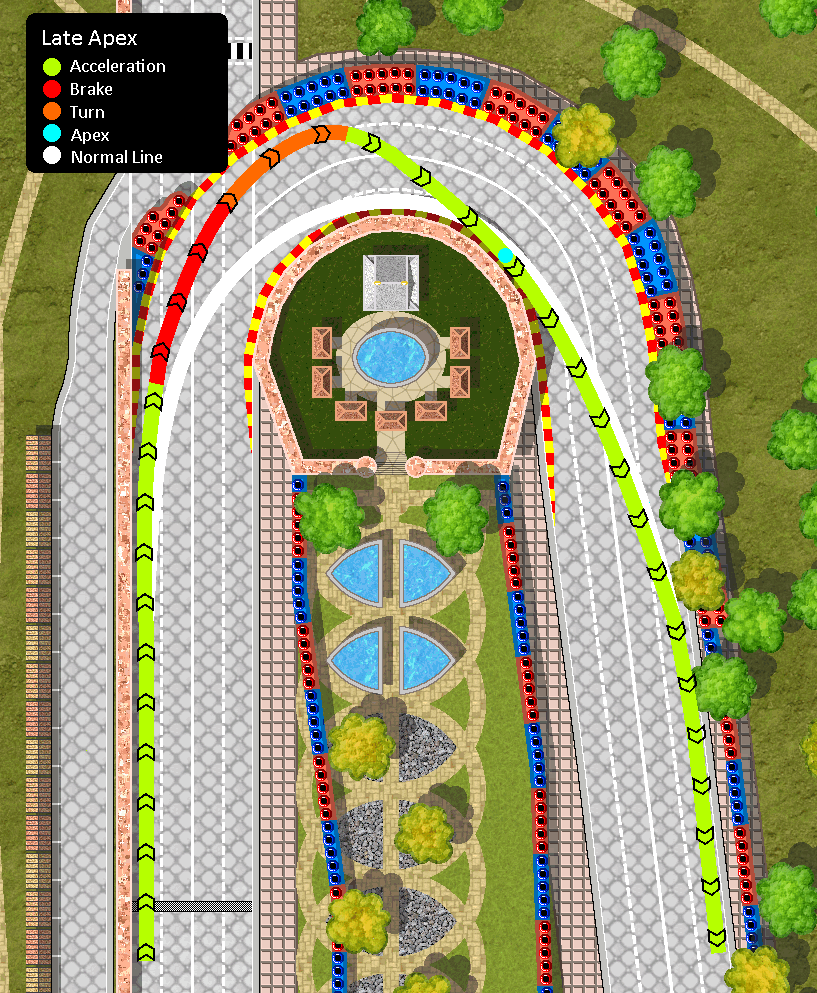
Can you see how delaying your turn and going deeper into the corner, results in a straighter exit? A straighter exit means a faster exit because there is less turning to do. This means you will reach your top speed sooner after the corner because you will have started accelerating sooner and therefore been accelerating for longer than any car that took the standard apex.
Late apexing is also a shrewd idea if you are not close enough to the car in front to overtake at the corner. Just accept that you will not get past them at the corner. Instead, trigger the car's late apex mode and aim for a faster, straighter exit to wallop them with brute speed for an overtake on the straight.
Early Apex
In an Early Apex, the driver aims to hit the apex earlier, which can be advantageous in sharper corners where a quick change of direction is necessary. A series of twisty corners might warrant an early apex in some of the early corners to set you up in a better position for the later corners. Early apexing can also help if the car has oversteer. The downside of an early apex is it will lead to a slower exit speed from the corner. So, you will need to use all your skills to minimise this loss of speed.
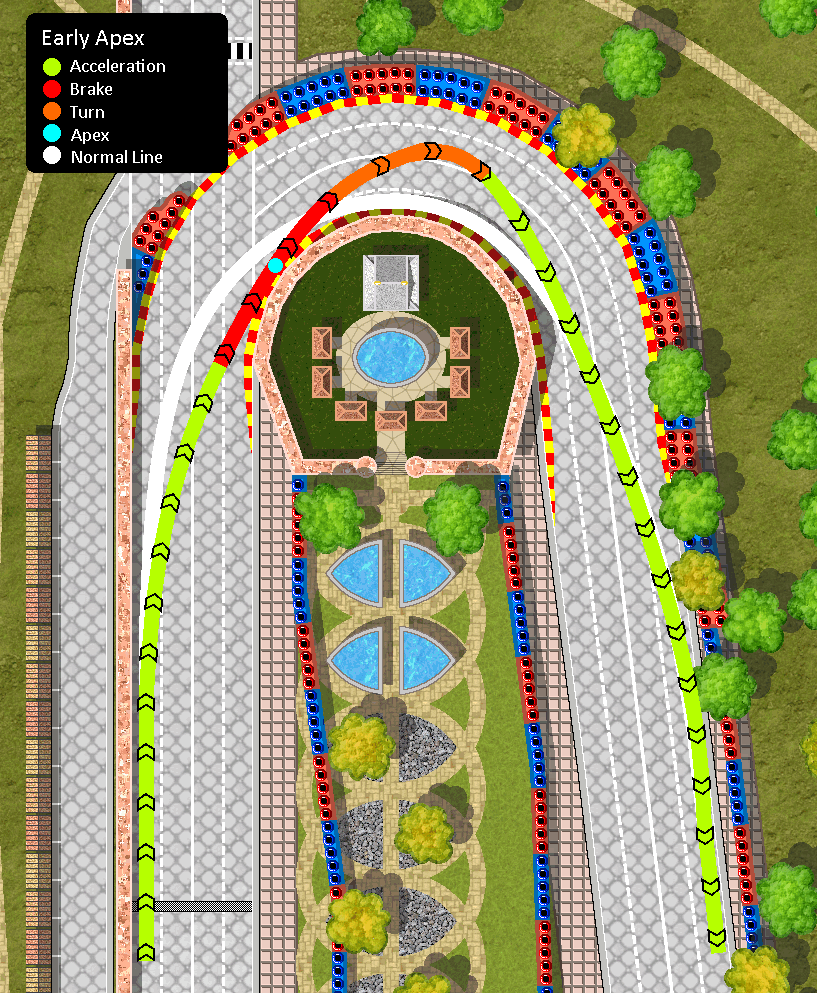
Some overtaking manoeuvres can be helped by taking an early apex. Its a way of saying, "This corner is mine", denying the leading car the perfect line through that corner and denying that car the ability to defend it. The overtaking car's exit from the corner will be compromised as their line will be utter rubbish on the exit. However, the overtaking car can slow and fade over to the outside in front of the overtaken car, effectively limiting that car's speed to that of their own. Naughty, but fair. So if the defending car suspects this chicanery, they may consider getting to the apex early to block an overtake. Drivers are constantly trying to outsmart each other in a mental game of Guess-Who?, while screaming down the track at hundreds of miles an hour.
One of my favourite drivers, Alonso, is a master of this. While his opponents were still reading their Dummies Guide to Driving a Car Goodly, the grandmaster Alonso was strategising like a sneaky cat. Sometimes, however, his opponents would go blubbing to the stewards, resulting in Alonso being told off for being a very, very naughty boy.
Mid Apex (Default)
The Mid-Apex is standard balance between early and late apexing. Let's call it vanilla, compared with mint-choc-chip and raspberry ripple of early and late apexing. This enables the driver to maintain speed through the corner, both through entry and exit, while still retaining their position for the next part of the track.
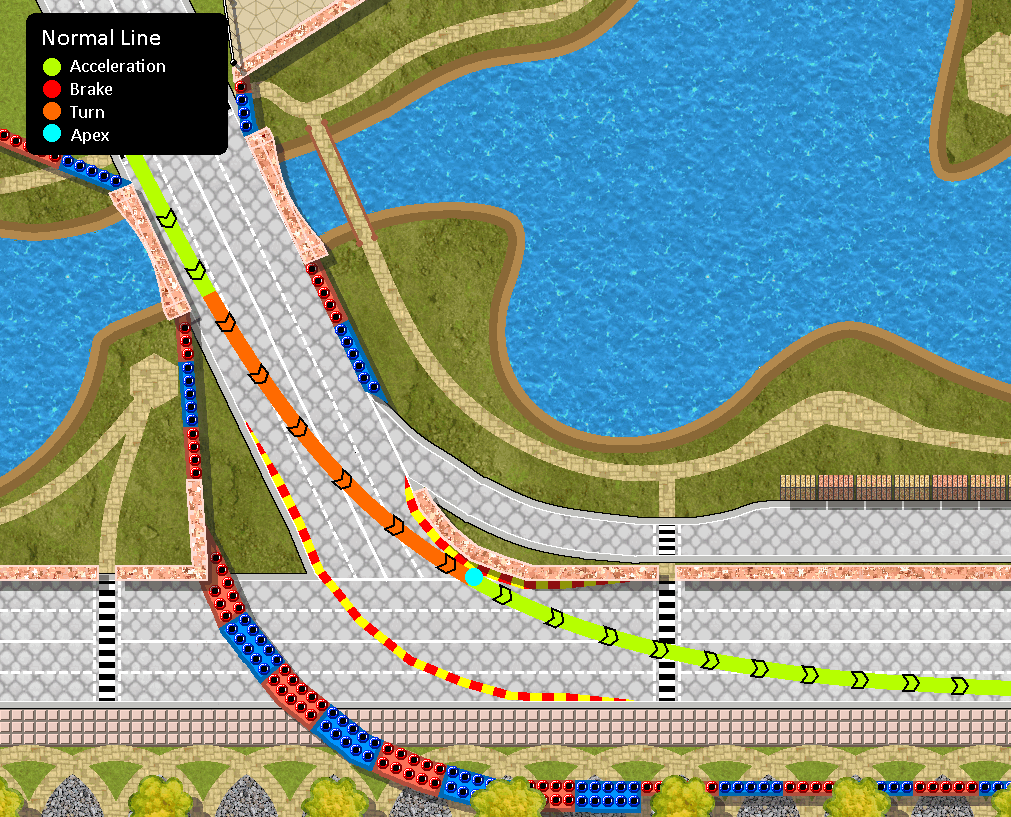
The final corner on the first track of Crossroads Junction in Retro Grand Prix is the perfect place to use Mid-Apexing in the forward direction. If you nail the bananas, you can keep the pedal to the metal and experience perfect zen without having to let off the throttle. However, when you race the track in the reverse direction, a spanner is thrown into the World Machine to mess up your day. You will normally have to let off the accelerator,or even tap the brakes, because there is a very narrow bridge section just afterwards. Accuracy and control of the car are more important than reckless, raw animal speed. Otherwise, you could end up kissing the tire-wall, or even worse, whacking the bridge. Missing out on the odd fastest lap is nothing compared to keeping the car on the track and avoiding the scowls of your mechanics if you go back to the garage with a busted-up car.
The Choice of Apex
The choice of the apex you use on a corner is determined by several elements.
The way a car is set up can affect how it handles. This can significantly impact the driver's ability to hit the apex. If you lack confidence in your car's handling, then you will have no confidence in your own ability to perfectly hit your desired apex. It will be difficult to maintain the best speed if your car is understeering or oversteering. In Retro Grand Prix your car's abilities are abstracted into three categories; Top Speed, Acceleration and Aerodynamics. Your pit crew will automatically set up your car based on your team's characteristics.
The condition and type of tire can affect the amount of grip available during cornering. Fresh tires usually provide better traction, enabling drivers to hit the apex more aggressively. You will notice the difference with fresh tires in Retro Grand Prix and will be able to hit your apex with them. Also, in Retro Grand Prix [RGP] there are three types of tires; Wets, Soft and Hard Tires. Hard Tires will last the entire race in RGP without needing to be changed, but they will not provide as much grip. Soft Tires provide fantastic grip, road huggers, and will allow you to take corners with more confidence, but they will only last a set number of laps before they need to be changed. If you fail to change them, then a puncture is likely and you will have to limp back to the pits while other cars whizz past you, waving at you with an evil grin on their faces.
Contrary to the perception of Joe Public, Hard and Soft Tires have no tread pattern on them. This gives maximum contact with the road for more grip. Patterned treads do not give you grip, they take grip away. Wet Tires have a pattern that channels the water out to the sides of the tire, ensuring your tire is making as much contact with the road. If you used Soft or Hard tires in a race in wet weather, then there would be a layer of water between the tire and the road. This would cause a loss of grip and could even make you spin.
A track will be more difficult to drive on in the corners if it is wet or it is raining. Sudden or sharp turns can cause a spin, so more aggressive apexing should be avoided. Drivers in Retro Grand Prix will be more cautious when driving in the wet. You will need to use your Wet Tires in such conditions, so think about pitting if it starts to rain.
The design of a track, including elevation changes and the corner radii, can influence the most effective apexing strategy. If the elevation change squishes your car into the track, then your ability to turn will greatly increase. However, if the elevation change causes your car to feel lighter, for example as your car travels over a rise, then your grip with the road will be reduced and your ability to turn on a dime will diminish. Activate caution mode. Every corner has a unique personality. I guess that means the 'Senna S' at Interlagos in Brazil is the equivalent of your crazy uncle jiving to the Birdee Song at the family Christmas party. So you have got to be careful with those corners, ... do not make eye contact. Wait, bad idea. You need to definitely make eye contact with the corner so you need to see what you are doing. Drivers often need to adapt their approach based on the unique characteristics of each corner and the layout of the track around it. A moment's lapse in concentration and you could be making a one-way ticket to the tire wall. So stay awake. Sleepy time and cuddling up to your teddy bear will have to wait until after the race.
The Senna-S is a corner complex, a string of corners one after the other. So, let's take a look at a corner complex in Retro Grand Prix. Here is the back end of Crossroads Junction.
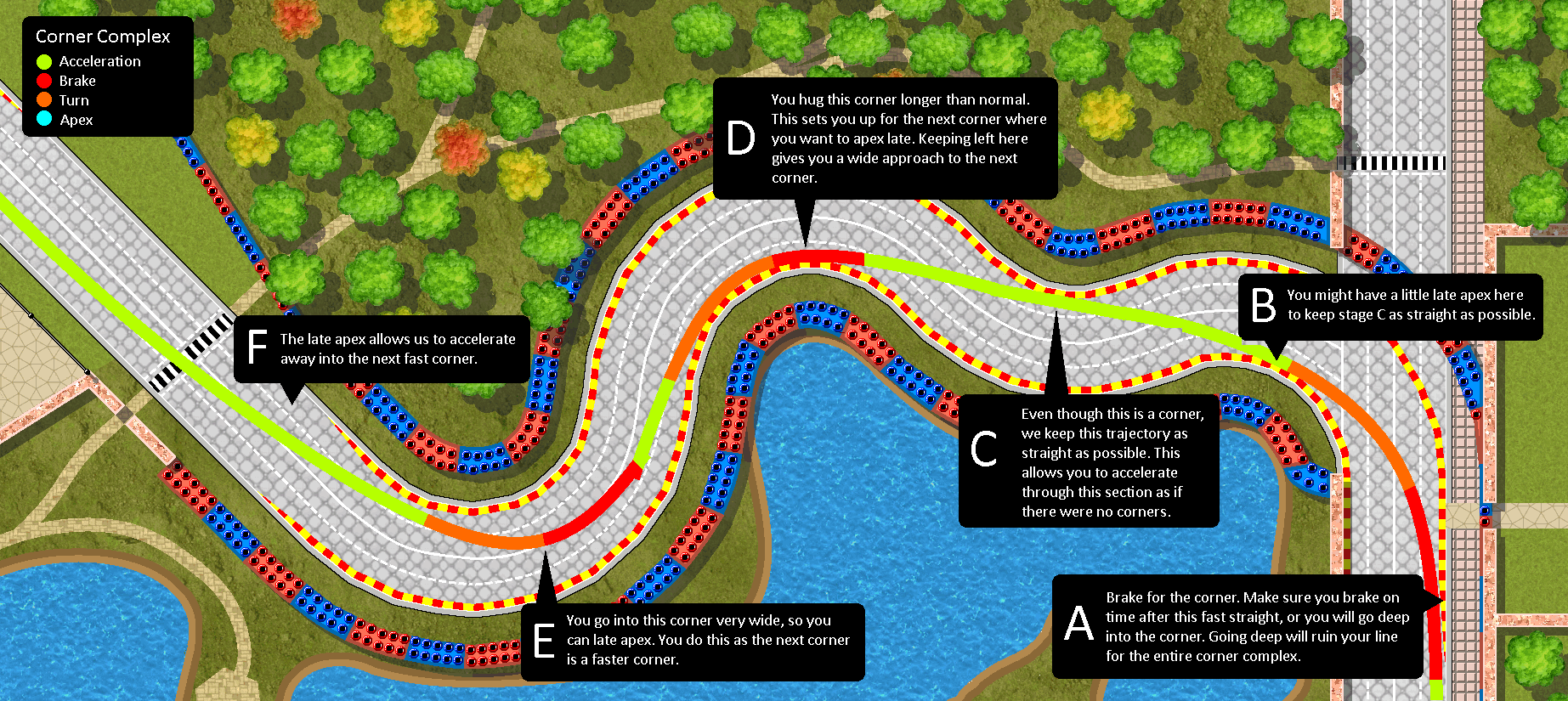
A - Brake for the corner. Make sure you brake on time after this fast straight, or you will go deep into the corner. Going deep will ruin your line for the entire corner complex.
B - You might have a little late apex here to keep stage C as straight as possible.
C - Even though this is a corner, we keep this trajectory as straight as possible. This allows you to accelerate through this section as if there were no corners.
D - You hug this corner longer than normal. This sets you up for the next corner where you want to apex late. Keeping left here gives you a wide approach to the next corner.
E - You go into this corner very wide, so you can late apex. You do this as the next corner is a fast corner.
F - The late apex allows us to accelerate away into the next fast corner.
Hitting the Perfect Apex
The suits of the press say the top drivers can place their cars perfectly around the corners, placing them millimetre perfect. This is very likely true, and I reject the claim that the press got a cheap job lot of tape measures from a hustler at the local market. So, armed with this likely tale of incredible perfection, let us look at the multiple ways to achieve your chosen apexing.
To hit the perfect apex you must brake in time for the corner. If you brake too late, you will go too deep into the corner and end up going too wide. This will result in you having to turn the car significantly more, causing you to lose a lot more time. Those seconds you lose will feel like an eternity. You will likely miss the apex altogether. Alternatively, if you brake too early, you will wonder why it is taking so long to reach to the corner. You will look at your watch, shake it a bit to check it is still working, then be plunged back to reality when your competitors out-brake you, pass you, and then zip off into the sunset while you are still waiting for the corner to arrive. Additionally, super-skilled drivers can achieve a tighter apex by using a technique called trail braking. This involves the driver gradually releasing the brake while turning. Perfect cornering is like dancing. You want to be the precise and elegant ballroom dancer, not the wedding-party guest who has had one shandy too many.
Smooth throttle and brake control are important when cornering. Applying the throttle or brake too aggressively can cause the car to spin or result in a loss of control. Remember that the team boss, the bloke wot signs the big-bucks cheques, and his army of engineers are staring at computer screens that monitor your throttle and brake application, so they will know it is your fault if you spin due to an aggressive use of the pedals.
Drivers use visual references to time when to brake, especially after fast straights. Use distinctive trees, road side markers or boards, wrecked cars that have previously come a cropper with their drivers sobbing at their side, or any other distinctive feature. Do not use the angry hedgehog shaking his fist at you as a reference point, because chances are he will have skedaddled by the next lap, probably already writing his letter of complaint to the track stewards about your lack of due care and attention while driving. If you can time your braking right, this will massively improve your ability to hit your perfect apex in the corners, which will result in you being able to bathe in the adoration from the crowd.
Advert.